
Psychiatry & TMS Blog
Milwaukee Psychiatrists
When Should I Go to Behavioral Health?
It can be difficult to know when it’s the right time to seek help for your mental health. Pay attention to how your daily life is affected. Go when your quality of life drops below your personal baseline, or when you cannot meet reasonable goals like showing up for...
What Are Common Behavioral Health Issues
Common behavioral health issues can influence thoughts, emotions, habits, and overall functioning. Below are some of the conditions I most commonly treat, along with the therapeutic approaches that guide care. Addictions such as alcohol, gambling, and stimulant...
What Does Deep TMS Feel Like?
Deep TMS uses a helmet-style coil that reaches broader, deeper cortical regions. The experience is similar to standard TMS, with firm scalp contact and rhythmic tapping. Session length and patterns depend on the device and specific indication. Stimulation Location and...
What Is the Next Step If TMS Doesn’t Work?
If TMS hasn’t led to meaningful improvement by session 20, I carefully reassess coil position, motor threshold, and dosing, and, if tolerated, increase settings to a clearly therapeutic level. At this point, I also encourage adding psychotherapy and considering...
Is TMS Approved for Depression?
Yes. TMS is FDA-approved for major depressive disorder. Some devices have additional clearances that depend on the indication and coil type. Does Insurance Cover TMS Therapy? In my region, most plans cover TMS for depression when the criteria are met. Medicare and...
Is TMS a Permanent Fix?
Depression behaves like other chronic medical conditions. TMS is an acute treatment that helps many people out of an episode more effectively than medication alone. After remission, I recommend continuing evidence-based medications and psychotherapy for at least one...
Safety, Side Effects, And Who Is A Good Match For TMS
Common, Usually Short-Lived Side Effects Scalp tenderness or headache early in the course. Brief facial or jaw twitching during stimulation. Driving and returning to normal activities are allowed immediately. Is Anger a Side Effect of TMS? Not typically. In controlled...
How I Explain TMS, What It Feels Like, And How I Track Progress
What TMS Therapy Is, In Plain English Transcranial magnetic stimulation is a form of neuromodulation. A magnetic coil sits on your scalp, quickly turning a magnetic field on and off. That changing field induces a gentle electrical current in the left...
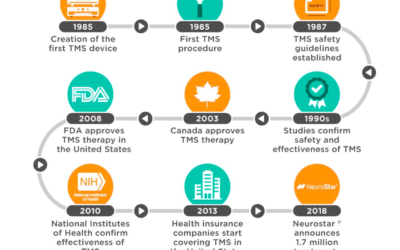
History of TMS for Depression
When Was TMS Invented? The investigation into Transcranial Magnetic Stimulation (TMS) and its profound impact on the brain has been an area of extensive research and neuroscience since the 1980s. However, it wasn't until 2008 that the FDA officially approved TMS as a...

Neuroscience of depression and treatment
TL;DR Depression affects 10% of people, causing symptoms like sadness, fatigue, and anhedonia (loss of interest). Brain regions involved in mood regulation, like the amygdala, hippocampus, and prefrontal cortex, are dysregulated in depression. Amygdala overactivity...